
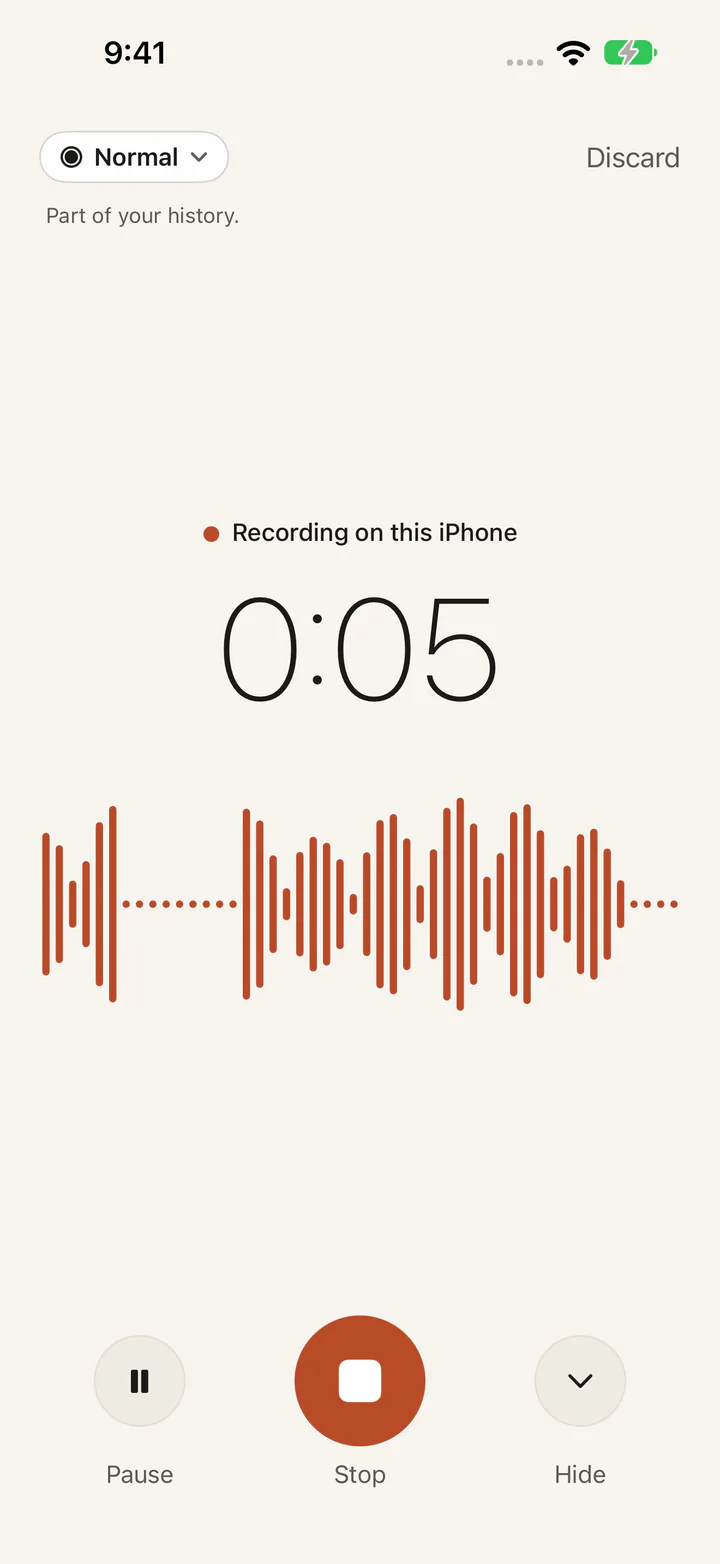
1. Pick a trigger, not a schedule.
“Journal every day at 8 PM” works for some people. For others it creates another obligation. A voice journal can be event-driven instead: after a difficult meeting, while walking home, after a date, when an idea will not leave you alone, or when you catch yourself rehearsing the same thought.
The trigger is simple: if I keep thinking it, I can say it once somewhere.
2. Do not start by organizing.
The biggest advantage of voice is speed. Protect that advantage. Do not pause to invent a title, pick a mood, choose tags or turn your first sentence into something quotable. Those are database concerns, not human-thought concerns.
A good first entry can literally begin with “Okay, I do not even know why this is bothering me, but…” The useful information often appears after you have already started.
3. There is no correct entry length.
A ten-second observation can be worth keeping. So can a twelve-minute decision you need to talk through. The better stopping rule is qualitative: stop when you are repeating the same point and nothing new is appearing.
4. Separate “capture” from “keep forever.”
People often censor a journal because they assume anything they record becomes permanent. That does not have to be true. Decide what kind of moment you are making.
- Normal: something you may want searchable as part of your history.
- Private: something you want to keep for yourself without feeding later intelligence or resurfacing.
- Burn: something you needed to say but do not want stored at all.
See how Smart Rant handles those three modes.
The recording happens first. Searchable words and retrieval make the archive useful later without making you label the moment up front.
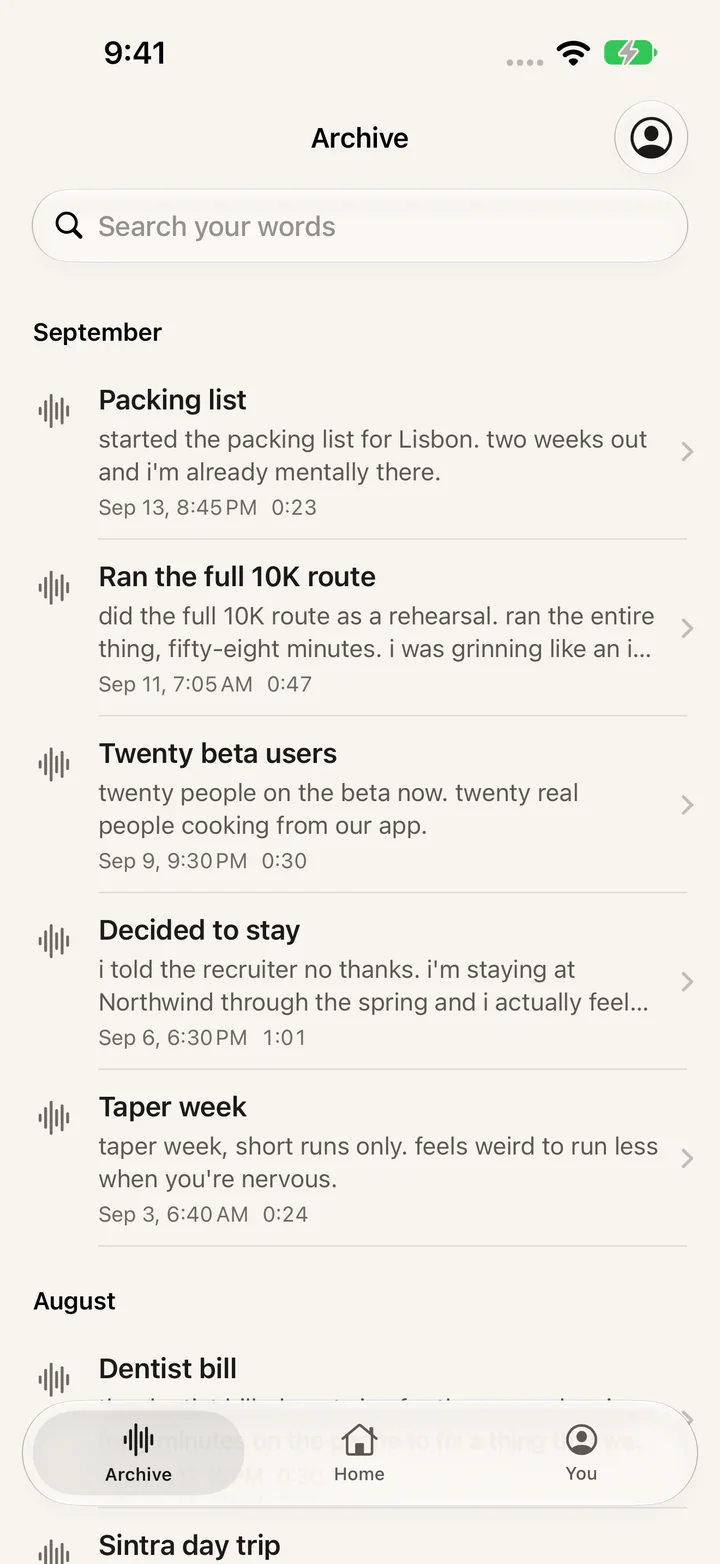
5. Make retrieval easier than capture.
A voice journal fails if it becomes a graveyard of unnamed audio files. You should be able to find a moment by the words inside it. Search is useful for literal recall; a source-backed question is useful when you do not remember exactly which recording contained the answer.
Example question: “What did I say about pricing the app?” is more natural than remembering which August recording contained the discussion.
6. Review on demand, not because the app demands engagement.
A journal does not need streak pressure to be valuable. The moment you are curious — “When did I start feeling differently?” or “What did I expect before the interview?” — is a better reason to return than a notification that says you have not journaled today.
What should you talk about?
Anything you would otherwise replay internally. Common categories include:
- something that happened and the part you cannot stop thinking about;
- a decision where you keep changing your mind;
- an idea you do not want to lose;
- a memory you want in your own voice;
- a win that will feel ordinary six months from now;
- what you expect to happen before a high-stakes event.
A voice journal does not have to replace writing.
You can use speech for fast, emotionally immediate capture and writing for slower synthesis. The right format is the one you will actually use when the thought happens. Compare voice journaling and writing in detail.