
The first job of a rant can be externalization.
A thought inside your head can be fast, repetitive and hard to separate from the feeling attached to it. Speaking or writing forces that experience into a sequence: this happened, then I thought this, then this part bothered me. That shift does not magically solve the problem, but it can make the experience easier to examine.
Researchers often study related processes under names such as expressive disclosure, expressive writing and affect labeling. They are not identical to casually ranting into your phone, but they offer useful clues about why putting an experience into language can sometimes change how we relate to it.
Important: Smart Rant is a journaling and reflection tool. It is not therapy, diagnosis or medical care, and this guide is not medical advice.
Putting feelings into words can change the task.
In a well-known 2007 neuroimaging study, Matthew Lieberman and colleagues examined affect labeling — putting a feeling into words. The work found different patterns of brain activity when people labeled emotional stimuli compared with simply reacting to them. That does not prove “ranting calms the brain,” and it would be an overreach to make that claim. It does support a narrower idea: naming an emotional experience is not the same cognitive task as merely experiencing it.
Research on expressive writing also suggests that emotional expression can be more useful when it includes some cognitive processing — trying to make sense of what happened, not only replaying the same grievance. A 2002 study by Ullrich and Lutgendorf is one example: the combination of emotional expression and cognitive processing mattered more than treating “writing anything negative” as automatically beneficial.
So is venting good for you?
There is no universal yes. “Venting” can mean very different things: telling a friend what happened once, repeatedly rehearsing anger for an hour, writing privately, speaking into a recorder, or seeking validation from a public audience. Those behaviors should not be treated as one intervention.
A more useful question is: what happens after you get it out?
- If speaking helps you identify what actually bothered you, the rant created information.
- If you notice your story changing after a few days, keeping the earlier moment can reveal that change.
- If repeating the rant only intensifies the same anger and nothing new appears, continuing may not be useful.
- If the issue requires action, support or professional help, a journal should not become a substitute for that next step.
A simple “rant → reflection” pattern.
- Say the unedited version first. Do not turn the first minute into an essay.
- Stop when you are repeating rather than discovering. More words are not automatically more processing.
- Leave it alone for a while. Immediate analysis is not always necessary.
- Return with a specific question. What part bothered me? What did I expect? What changed?
- Compare against the original. Your memory of what you “always felt” can differ from what you actually said.
Smart Rant keeps the original audio beside searchable words so returning later does not mean replacing your memory with an AI summary.
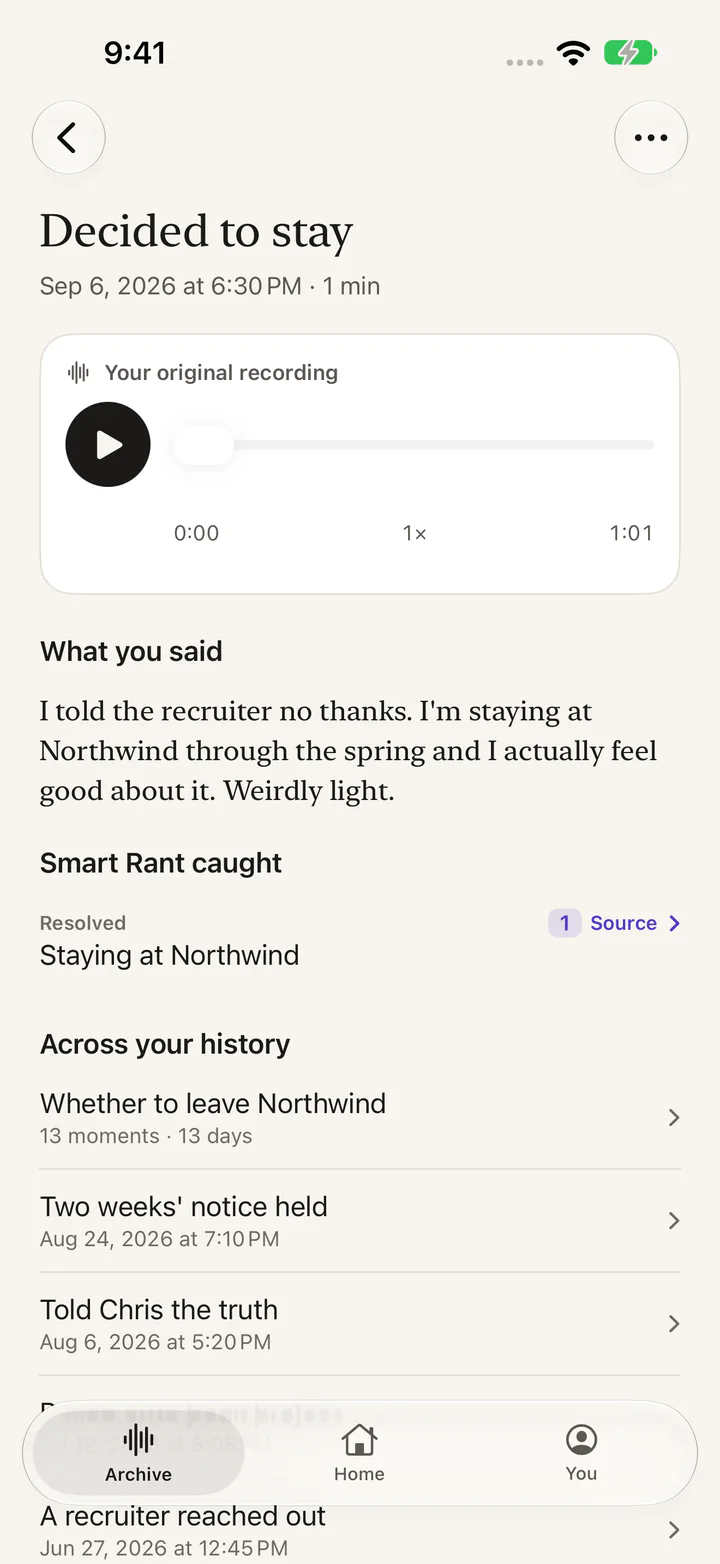
Why Smart Rant is built around the original recording.
Smart Rant starts with capture rather than advice. The original audio remains the record. If you later enable intelligence, Ask is designed to answer from your own moments and show the source recordings behind the answer. Relive can put moments in sequence so you can hear change rather than receive a generated story about yourself.
And sometimes the right choice is not to build memory at all. Private and Burn modeslet you keep a moment outside the intelligence system or delete it when you stop.